


Have you ever thought about the physical aspects of the internet? Just like you need a plot of land for a house, your website needs a plot of cyberspace to exist online. Websites are programs that need to be stored and backed up on computers, and their purpose (right now) is to provide readers and customers with a description of who you are and what you do, and hopefully, encourage them to purchase a product or service from you. So to be profitable, your website needs to be accessible to a large number of people. It’s the only thing you really own and control on the internet.
Website owners must rent a space for their websites from companies that have the infrastructure to render their content, images, and sales pages accessible to the world around the clock. That’s called hosting.
When you use a hosting service, you pay the hosting company to let your website occupy space on their servers: large, dedicated computers equipped with different processor chips than your personal computer. You won’t have to worry about programming, certificates, security, website speed, and lots of other issues because the hosting company does all that for you.
However, if something happens to the physical server, the website could go offline, so hosting companies have redundant servers to take over if there is a problem.
Obviously, the whole internet is housed on servers. Larger companies and universities own their own servers and have hundreds of trained employees to keep them up and running, and smaller companies work with dedicated hosting companies to help them keep their sites online. None of this infrastructure runs without energy or maintenance, and the people who know how to make it run don’t work for free, so it follows that there are different tiers of service within the hosting industry.
This is one service you will require the moment you start setting up your website. Even if you start with a free plan, it’s best to become familiar with the advantages and disadvantages of different hosting options.
Overview of Free Hosting
When you’re just getting started, free website hosting is the right choice, but only for a while. It’s great to be able to start out with a lower financial commitment while planning for the upgrade at the right time.
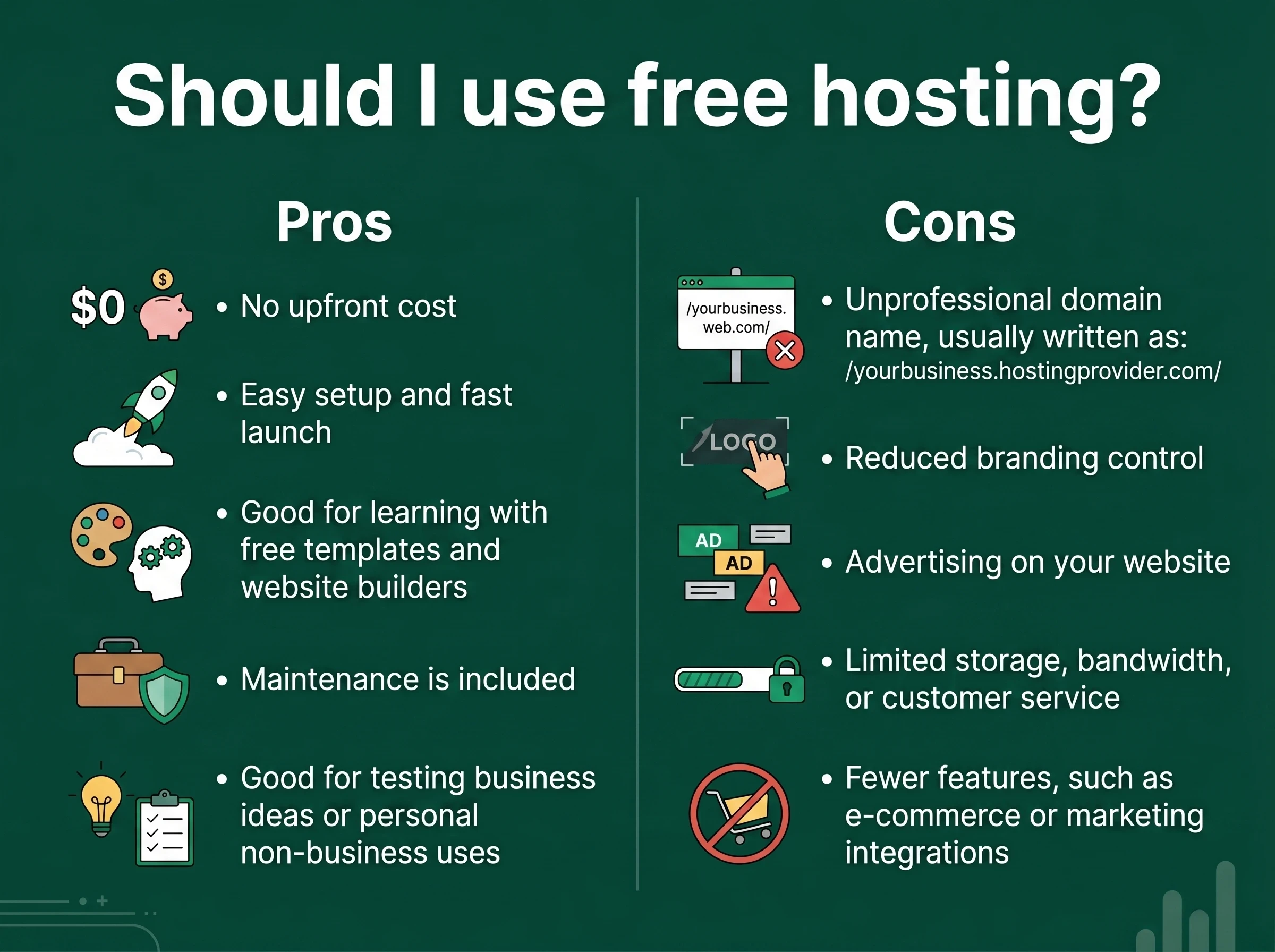
Here are 5 advantages of free hosting:
- No upfront cost.
- Easy setup and fast launch.
- Good for learning with free templates and website builders.
- Maintenance is included.
- Good for testing business ideas or personal non-business uses.
Hosting companies provide technical support so that even people with no technical expertise can have their own sites. Themes and templates make it easy to place headers, footers, and menus, and the amount of information available to beginners is staggering. Just type the phrase “how to build a website” into your favorite search engine if you don’t believe me!
But free services do have operational costs: so here are 5 disadvantages of free hosting:
- Unprofessional domain name, usually written as: /yourbusiness.hostingprovider.com/
- Reduced branding control.
- Advertising on your website.
- Limited storage, bandwidth, or customer service.
- Fewer features, such as e-commerce or marketing integrations.
Not having a dedicated domain name can impact your credibility because people know it’s a free website. Branding (your logo, colors, style, etc.) can be impacted by the ads that are placed on your website because you have no control over which ones your visitors see. Storage limits can impact the number of pages and images that you can have, and that can mean slower loading speeds.
You can plan to upgrade to paid hosting when you need a custom domain to start generating revenue or building credibility. A custom domain costs from $10 to $40 dollars, depending on the domain extension (such as .com, .org, .it, .net), the registrar, and whether the domain name was already owned by someone else. Some names are considered “desirable” or “premium”, and are therefore much more expensive. Check out this post for help with choosing your domain name.
Always check the renewal costs of your domain name, because some registrars offer a discount for the first year. A custom domain name is a good investment to make early on because it is cheap and it conveys credibility to your business.
Beyond Free Hosting
The next options to consider are paid hosting plans. Some basic paid plans offer a dedicated domain name included for the first year. Shared hosting requires you to do more of the technical work, but it is cheaper. When you opt for managed hosting, you pay more, but the provider handles almost all of the updates and optimization work.
The good part about these costs is that they can be recorded as operating expenses on your P&L statement. Obviously, your business will have to spend money to stay in business. The most important thing is to have the right type of hosting for your website, considering the current situation of your business.
This was such a clear and practical explanation of hosting; it really helped me see the bigger picture. I’m currently exploring options for my health website and weighing the pros and cons of free vs. paid hosting. Free hosting seems like a good way to start with minimal risk, but I can see how the lack of a professional domain and limited features could affect credibility, especially in the health niche, where trust really matters.
I think a paid plan with a custom domain might be the better long-term investment. But do you find that managed hosting is worth the extra cost for beginners, or is shared hosting usually enough until the site starts to grow?
Hi Alice,
Personally, I think managed hosting is always better because the host will handle updates and backups for you. This has been especially important for me. My websites are hosted on Wealthy Affiliate, and no matter what happens, Site Support will take care of it.
Before deciding on a hosting contract, it’s important to understand what services are offered, and who is responsible for backups, security, and other technical needs. Shop around, because it’s possible to find affordable managed hosting solutions.
This was a very clear explanation, especially the comparison between hosting and renting a plot of land for a website. I think that makes the idea much easier to understand for beginners who may not be technical at all. I also liked the part about free hosting being useful only for a while, because many people probably start there without realizing the limits. One thing I was wondering is this: for a brand-new small business website, what signs would tell you it is time to move from free hosting to paid hosting?
Hi Hanna,
Since free hosting depends on the host having their name in the URL, I think it’s important to get your own domain name as quickly as possible. A good domain name is part of your brand’s foundation.
Switch to affordable paid hosting as soon as you can manage to. And remember, it’s a business expense: you can claim it on your tax return.