

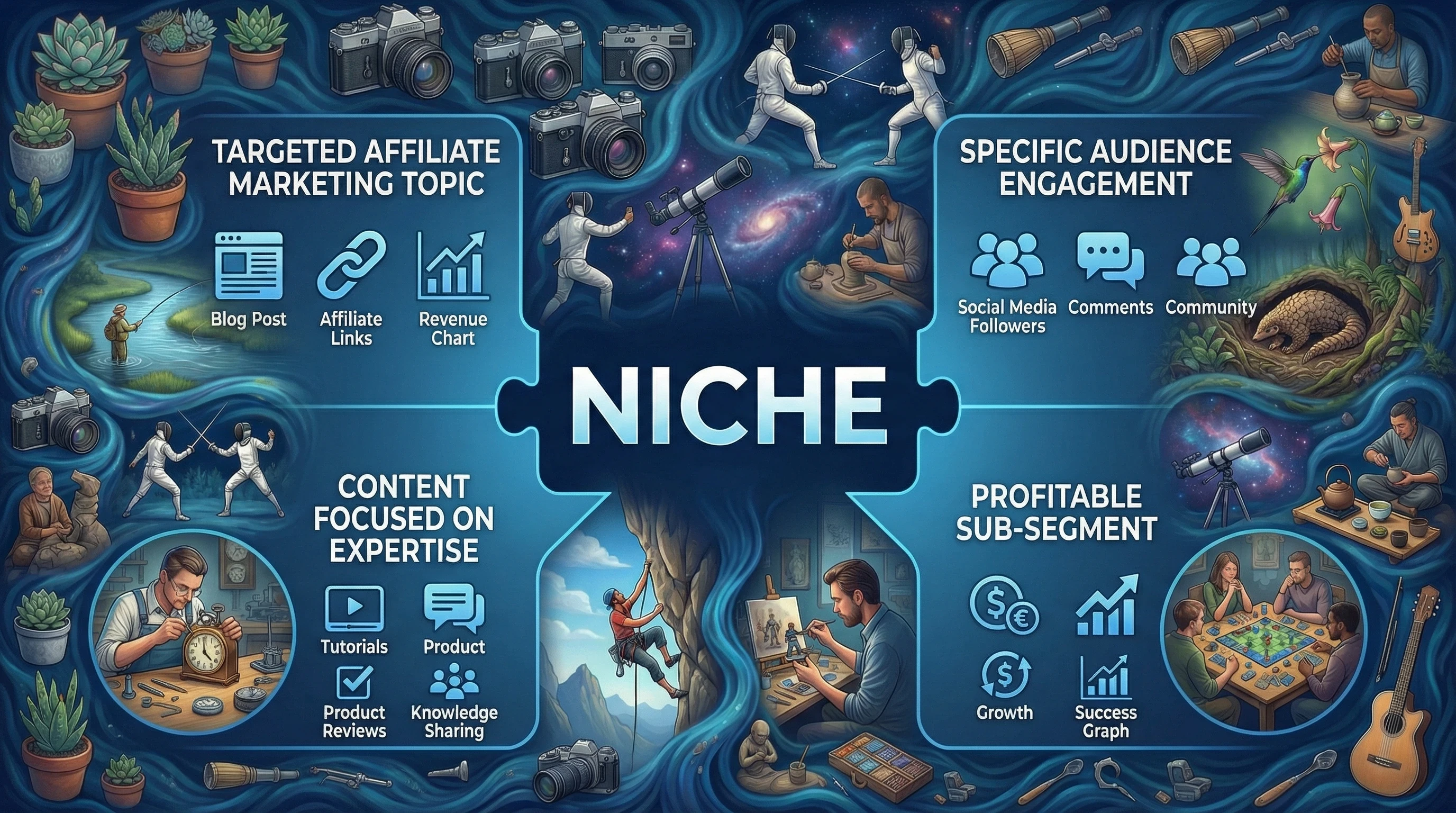
Whenever you land on a website, you usually can tell exactly what it is about. We call this a “niche”. (Incidentally, both /nitch/ and /neesh/ are correct pronunciations: use the one you like best.) It’s the main topic of the blog: its area of expertise or business. Before setting up a website, any blogger needs to decide what kind of content they are going to be sharing.
Think about yourself and your experience first. A good niche is a topic you find interesting. It could be related to your job, your culture, or your hobbies, and you’ll never get tired of talking about it. However, if you’re setting up an affiliate marketing website, your niche should also include products or services to promote.
I’ve set up several websites during the past decade, and I’d like to share my reasoning process. First, though, we need to review what affiliate marketing is—and what it is not.

Understanding Affiliate Marketing
Affiliate marketers use their writing and marketing skills to promote products and services to potential customers, and each sale earns them a commission. No inventory or ownership in the company (or companies) that own and sell said products and services is required. Obviously, affiliate marketing can overlap with proprietary marketing if, for example, the website owner also offers their own products and/or services directly to customers.
Affiliate marketing is not hyping unfamiliar products or services to make a profit. Having experience with the offerings you promote is crucial. People shop online all the time now: they compare prices and benefits of different products, so the blogger’s ability to build trust and authority is going to make a difference in how well the business does financially. Remember, an affiliate marketing website is a business, not a hobby, and the goal is to produce an income.
There are also affiliate disclosure rules to follow! One of these rules states that bloggers have to tell their readers about the presence of affiliate links in their posts, so here it is: the links in this post that identify companies are affiliate links. Furthermore, if you plan to use AI to write your articles or do other things on your blog, you will have to disclose that too.
Since this blog is being used as an example, I’ll tell you what products and services I advertise now and brainstorm about what I could promote in the future. I’ve used the Wealthy Affiliate platform to build this website and others before it: WA teaches about WordPress (the blogging software), marketing strategy, SEO, and social media marketing. WA also offers hosting, so in the future, I will be reviewing hosting companies. One of the best parts about joining the platform is the online community. There is always someone to chat with, whether you’re just wanting to say hi to someone, or answer questions or talk about some aspect of affiliate marketing or website building. It’s a great place to find encouragement.
I’ve also become an affiliate of iubenda, an Italian company that helps businesses ensure compliance with global privacy laws. They prepare privacy policies, cookie banners, and all sorts of other data compliance software and documents. In the future, I plan to write a post comparing different privacy companies, and I also promote products and services that I use for my business, such as business cards and notebooks. Of course, I can also become an Amazon Affiliate.
A third company I’ve decided to promote is Everyday Dose, a mushroom coffee. This may seem like a deviation from my website scope, but I really love this product. People like to drink their tea and coffee while they are working, so I think it fits nicely. Everyday Dose is made with functional mushrooms, collagen protein, and nootropics to promote laser focus, improved mood, all-day energy, and reduced stress. It tastes like regular coffee and it has really improved my digestion, so I hope you’ll give it a try.
Name, Domain, and Branding
Deciding on a website name doesn’t have to be tricky. The name for this website (there is no physical store) seemed perfect because I’ve always worked from home and I want to help other people start their own home-based businesses. So “Home Business” clearly identifies what I’m going to be talking about in most of my articles, and “Haven” conveys the idea of protection, resources and opportunities, as I wrote on the “About” page.
I followed a different train of thought when I named my teaching and translating website. I decided to use my last name and the word “communications” because I wanted it to focus more on me as a professional. At first, I set up the domain name with a hyphen between the two words, but later I changed it because search engines treat domains with hyphens differently than domains without hyphens. Incidentally, when you purchase a domain name, the timeframe is 12 months, with renewal after 11 months, and the price is usually affordable. However, if you want to change it later, like I did, you must purchase a new domain name and abandon your first choice. No spelling changes or refunds will be made.
Nothing requires your domain name and website name to indicate precisely what you do. For example, we all know that Amazon has nothing to do with the South American river. Your branding should be memorable or unique, but not necessarily explanatory or obvious. In my domain name, homebizhaven.com, I chose to abbreviate one of the words to make it shorter, but it still reflects the title of my website closely. I want this domain to convey the purpose of my website.
The concept of branding indicates the process used to create a unique identity for a company, product, or service using names, logos, images, graphics, and designs. Branding affects how your website is perceived, so again, you’ll want to spend some time thinking about how you want to be identified.

The next two sections of this post contain questions to consider when choosing a niche and a domain name. Now, let’s brainstorm!
Topics That Naturally Catch Your Attention
What do you like to read? What do you do in your spare time? What are you naturally good at? What do you love to talk about? Are you passionate about any issues or problems?
Blogs can be about food, pets, games, hobbies, sports, and anything else you might like to write about, and there are products and services connected to any topic.
Consider your life experience. Skills you’ve picked up from jobs, hobbies, or just living day-to-day could all spark potential niches. Maybe you’ve become a whiz at fixing gadgets at home, or you have a knack for styling that everyone appreciates: both DIY and haircare can be viable niches.
Even topics that you’ve become an expert in reluctantly or unexpectedly can be good niches. Have you been a caregiver for an elderly relative or recovered from a difficult illness or financial disaster? You could help someone just by telling your story and offering solutions. The image below shows one way you could organize your thoughts.
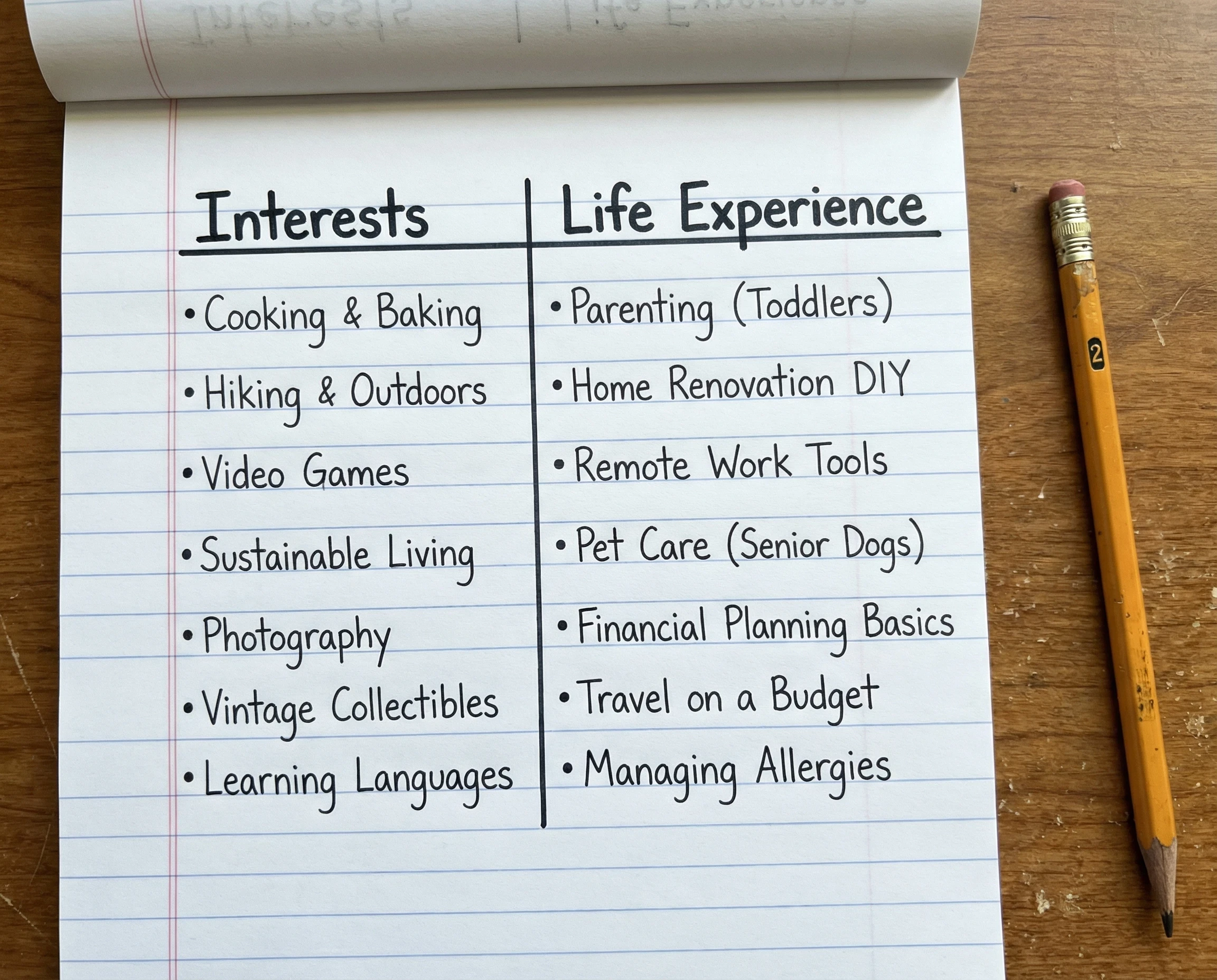
Your assignment: make a list of your interests, hobbies, job skills, and general experience that you’ve gained through everyday life. If you’re having trouble identifying a topic, ask your friends or relatives to tell you what they think you’re interested in. They will be able to tell you what you tend to bring up in a conversation.
Find Problems That Lead to Purchases
After identifying a possible niche, you need to start thinking about getting customers—or rather, people who buy things because you suggest them. You should record your own answers to the questions below, and maybe interview other people for more input.
- How do you go about searching for answers when you have a problem?
- Which websites do you consult?
- Which questions do you ask to research the solutions?
- Which products do you buy online?
- Which products do you prefer to buy in person?
Try to focus on issues that people need help with consistently instead of one-time purchases, but remember that some one-time purchases, such as cars and homes, have many additional aspects that you could focus on. To expand on the list in the image above, a website about senior dogs might promote food and accessories, and it might feature posts with medical advice for owners of older dogs.
A hobby or travel niche would include both one-time purchases (such as expensive equipment or once-in-a-lifetime trips) and recurring purchases (such as tools, accessories, or hotel rooms for weekend getaways).
Digging into consumer behavior can also help. Questions like “What’s the best solution for issue ABC?” or “How do I solve problem XYZ?” can tell you where people are investing time and energy into looking for solutions. Market research can also help you identify gaps in the market you could fill, or determine whether the niche you’re considering is too saturated.
Doing research into these aspects of your niche will help you decide which products and services would be more aligned with the purpose of your website.
The Comments Section
Here’s where the rubber meets the road. Please share your experience with website and domain names so that other readers can learn from your experience. If you’re new to this process, leave your questions and I’ll see if I can help you.
Hi, it has been a while since I had this trouble of choosing a niche and domain. I think definitely when I first started out I had this problem big time and actually the niche and domain I initially chose didn’t do me too many favours. When I started I was basically just reviewing clickbank products. I wanted to transition from Google Blogger to WordPress after making my 1st affiliate commissions and my site really was all over the place and worst part as someone pointed out that I didn’t have a defined niche that I should change what I’m doing. So I split my one website into 4 – I mean I suppose I learned quite a bit from this experience but even now I know that one website is plenty. I actually now do wonder if I should have just stuck to one site and found a way for this to work with different categories. I suppose nicheing down is the best idea but I didn’t really know this at the time.
I understand completely! I’ve got several interests and they morphed into several websites. Normally, the advice we receive is to pick one niche and develop it, but after it gets off the ground, we can do the same thing with another niche.
It’s important to pick something you love, and that you are naturally drawn to. When you love your job, it’s a lot easier.
Choosing a website name and domain is an important early decision because it shapes how your audience perceives your brand. From my experience, the best domains are simple, memorable, and closely aligned with the core topic of the site without being overly restrictive. It’s also wise to check availability across domains and social platforms to keep branding consistent. Taking time to think strategically about your niche and name can make long-term growth and recognition much easier.
I think you’ve highlighted a very important aspect of opening a business: there are many important early decisions regarding branding that will impact the business. It’s best to think things through and do suitable research to make sure that the business is positioned correctly.